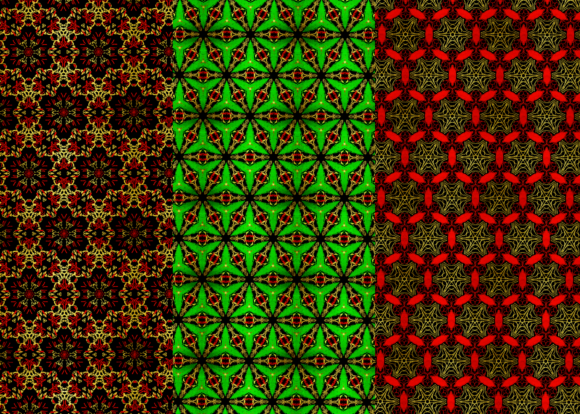
Art Deco Patterns: Timeless Geometry for Modern Design
Walk through any major city and you'll spot them—bold geometric motifs etched into skyscraper lobbies, stylized sunbursts on vintage theater marquees, and symmetrical fan motifs that still feel startlingly contemporary. Art Deco patterns have outlasted nearly every design trend from the last century, and their resurgence in digital and print media suggests they're not going anywhere. But what makes these patterns so persistently useful, and how can modern creators actually put them to work?
What Defines Art Deco Patterns, Really
Born in the 1920s and flourishing through the 1930s, the Art Deco movement rejected the flowing, organic curves of Art Nouveau in favor of something sharper and more industrial. Art Deco patterns are fundamentally about geometry made glamorous. Think stepped ziggurat forms, repeating chevrons, elongated trapezoids, and the iconic sunburst motif that radiates from a central point. There's a mathematical precision to the work—lines are clean, angles are deliberate, and symmetry reigns.
The materials that originally carried these patterns tell you something important about their character. Chrome, lacquer, polished stone, and inlaid wood all demanded designs that could be precisely executed. That precision translated into patterns built from repeating arcs, parallel lines, and nested geometric shapes. The result was ornamentation that felt luxurious without being fussy—a balance that explains why these patterns work so well in contemporary contexts where minimalism and maximalism constantly negotiate territory.
Core Visual Signatures to Recognize
If you're evaluating whether a pattern truly belongs in the Art Deco camp, several telltale markers help with identification. The stepped or tiered pyramid shape appears constantly, echoing the setbacks required by 1920s zoning laws for skyscrapers. Sunburst and fountain motifs radiate energy outward. Chevrons and zigzags create rhythm across surfaces. And the fan motif—overlapping arcs spreading from a narrow base—shows up in everything from wallpaper to wrought iron gates.
Color palettes in authentic Art Deco patterns tend to favor high contrast. Black and gold, cream and deep navy, silver paired with jade green, or ivory against ebony. Modern interpretations have expanded this considerably, but the high-contrast principle remains central. Without sufficient tonal separation, these patterns lose their graphic punch and start feeling muddled.
Why Designers Keep Returning to These Patterns
There's a practical reason Art Deco patterns refuse to fade into historical footnote status. They solve a persistent design problem: how to add visual richness without sacrificing clarity. Unlike ornate Victorian patterns that can overwhelm the eye, Art Deco geometry provides structure. The repeating elements create predictable rhythms that the brain processes easily, making them ideal for backgrounds, branding systems, and environmental graphics where readability matters.
They also convey cultural associations that many brands find valuable. Art Deco evokes an era of optimism, technological progress, and metropolitan sophistication. A startup aiming to project confidence might borrow from this visual vocabulary. A hotel renovation might use Art Deco floor tile patterns to signal old-world glamour updated for contemporary taste. The associations aren't subtle, but they're widely understood, and that communicative efficiency has real value in branding and marketing contexts.
Application Across Different Environments
The versatility of Art Deco patterns becomes apparent when you examine where they actually show up in practice. This isn't a style confined to historical preservation projects or themed events. Architects, interior designers, graphic designers, and even UI specialists have found ways to adapt these motifs for specific functional purposes.
Interior Design and Architectural Details
Floor tile installations remain one of the most common contemporary uses. A black and white Art Deco floor pattern in a bathroom or entryway instantly establishes character without committing the space to a period-faithful reproduction. Wallpaper manufacturers continue releasing Art Deco collections, and the better ones understand that scale matters—oversized motifs on a feature wall create drama, while smaller repeats work for entire rooms. Lighting designers incorporate the stepped geometries into sconces and pendants, using the shapes to direct and diffuse light in interesting ways.
For commercial interiors—restaurants, boutique hotels, co-working spaces—these patterns help differentiate environments in a market flooded with generic modernism. An Art Deco-inspired ceiling treatment or custom millwork detail gives patrons something to photograph, and in the social media era, that's no small consideration.
Graphic Design and Brand Identity
Logo designers have long borrowed from the Art Deco toolkit. The geometric precision scales well, reproducing clearly at sizes from business cards to billboards. Borders, frames, and accent elements derived from Art Deco patterns can unify a visual identity system without overwhelming the core mark. Event invitations, particularly for galas, awards ceremonies, or corporate milestone celebrations, frequently use these motifs to signal formality and significance.
One observation from working designers: the trick with Art Deco in branding is restraint. Using one or two structural elements—perhaps a stepped rule line and a simplified fan motif—usually works better than layering every geometric device from the period into a single composition. The patterns should support the brand's message, not compete with it.
Digital Interfaces and Web Design
Here's where things get interesting. Art Deco patterns have made unexpected inroads into UI design, appearing as subtle background textures on landing pages, geometric dividers between content sections, and loading screen animations. When executed with appropriate opacity and scale, the geometry adds depth without compromising legibility of overlaid text. Several luxury e-commerce sites use Art Deco-inspired framing devices around product photography to create a premium contextual frame—the visual equivalent of good packaging.
App designers working on fintech products have also experimented with these patterns. The association with banking architecture of the 1920s and 1930s—those grand banking halls with their geometric plasterwork and brass detailing—creates a subtle resonance for financial brands. It's associative rather than literal, which is precisely what makes it effective.
Textiles and Product Surfaces
Fashion cycles have repeatedly pulled Art Deco motifs back into textile design. Embroidered geometric patterns on evening wear, printed silk scarves with sunburst repeats, and accessories featuring fan motifs all appear with reliable frequency. The patterns adapt well to both jacquard weaving and digital printing, offering flexibility across manufacturing methods and price points.
Product designers incorporate Art Deco surface patterns onto everything from phone cases to furniture upholstery. Ceramic tile makers continue producing Art Deco lines because demand remains steady—homeowners renovating period properties need historically appropriate options, and designers working on contemporary projects often want exactly the same patterns for entirely different reasons.
Selection and Implementation Considerations
Before committing to Art Deco patterns in a project, a few practical questions deserve attention. Scale is the first concern—what reads as elegant on a fabric swatch may become aggressive when applied to an entire sofa. Test at full size, and don't assume a pattern that photographs well on a small sample will work at installation scale.
Color context matters enormously. The classic high-contrast black-and-gold combination that works brilliantly in a hotel lobby might feel garish in a residential bedroom. Muted palettes—charcoal and warm gray, or dusty blue with cream—can soften the geometry while preserving the structural integrity of the pattern. The goal isn't historical accuracy; it's effectiveness in the specific space you're designing.
For digital applications, performance considerations come into play. Complex repeating patterns implemented as large image files can slow page loading. CSS-based geometric patterns or SVG implementations often provide cleaner results with smaller file sizes. Several front-end frameworks now include Art Deco-inspired geometric components that can be customized without adding significant load time.
Where the Pattern Libraries Live
For those looking to incorporate Art Deco patterns into their work, several resource categories exist. Stock asset platforms offer vector collections specifically organized by period and motif type. Museum archives—particularly the collections of the Victoria and Albert Museum and the Cooper Hewitt—provide high-resolution reference imagery that's invaluable for understanding authentic proportions and color relationships before adapting them.
Independent designers on marketplaces like Creative Market frequently release Art Deco-inspired pattern sets with contemporary color palettes and extended commercial licensing. The quality varies considerably, so examining the preview images at actual intended scale before purchasing prevents disappointment. Some pattern designers also offer seamless tile sets specifically optimized for web backgrounds—useful if you're working on digital projects and need patterns that repeat cleanly across viewports of varying widths.
The Enduring Appeal Explained Simply
Ultimately, Art Deco patterns persist because they balance two impulses that often seem contradictory. They're ornamental without being chaotic. They're historical without feeling dated. They offer visual drama while maintaining the kind of structural clarity that works across media and scales. For professionals who need patterns that communicate sophistication without sacrificing legibility or versatility, the Art Deco vocabulary remains genuinely useful—not as nostalgia, but as a living design language that continues to earn its place in contemporary work.