Understanding the Appeal of Seamless Patterns Featuring Sweet Apple Imagery
What Makes a Pattern Truly Seamless
At the core of any repeating design is the concept of the seamless repeat. Unlike a simple tile that creates visible edges when placed side by side, a seamless pattern is crafted so that the boundaries between repetitions become invisible. This creates a continuous, uninterrupted surface, whether on fabric, wallpaper, or a digital screen. The illusion depends on precise alignment of motifs, colors, and negative space along all four edges of the design block. A Set of Seamless Patterns with Sweet Apple motifs leverages this technique, ensuring that every apple, leaf, and blossom flows effortlessly from one repeat into the next without a harsh cut-off. The result feels organic and immersive, much like walking through an orchard where the view never ends.
Designers achieve this flow through several methods. The most straightforward involves mirroring or rotating elements at the tile edges so they match when duplicated. Another common technique is the half-drop repeat, where each row is shifted horizontally by half the block's width, preventing obvious horizontal lines. For apple-themed patterns, this might place a whole apple at the center while half-apples decorate the top and bottom edges, ready to complete with their counterparts in the next row. The careful distribution of weight—ensuring no corner appears too heavy or too empty—is what separates a professional seamless pattern from a casual repeat. Digital tools like vector software now offer real-time previews of the repeat, letting creators fine-tune the flow until the eye can no longer spot the join.
Why the Sweet Apple Endures in Design
The apple as a visual symbol carries an extraordinary range of associations. It can represent health, knowledge, temptation, harvest, or simple childhood nostalgia. A sweet apple, specifically, evokes a sense of ripeness and pleasure—a fruit at its peak, ready to be enjoyed. In pattern work, this translates to vibrant reds, soft yellows, and crisp greens often accented by a delicate blush. Unlike more abstract or geometric motifs, the apple brings an immediate warmth and recognizability that can humanize a product or space. When arranged seamlessly, a field of sweet apples feels abundant yet ordered, comforting yet fresh.
Cultural references deepen the apple’s appeal. From the story of William Tell to the modern tech giant, the fruit straddles the familiar and the iconic. In home décor, apple motifs can evoke a farmhouse kitchen or a playful children’s nursery without being tied to a single trend. This versatility is a key advantage for any Set of Seamless Patterns with Sweet Apple themes—they can shift from rustic to modern simply by pairing them with different background colors or line styles. A watercolor apple on a linen texture suggests artisanal craft; a flat vector apple on a bold navy background feels pop-art and contemporary. This chameleon-like quality makes the motif useful across a wide spectrum of projects.
Core Characteristics of Effective Apple-Themed Patterns
When evaluating or creating a seamless apple pattern, several characteristics determine its success. Scale is paramount. A large-scale repeat with detailed apple illustrations works well for statement wallpapers or fabric for upholstery, where the viewer can appreciate the richness from a distance. A smaller, denser repeat suits apparel like dresses or shirts, where too much detail would become muddled. The Set of Seamless Patterns with Sweet Apple might offer multiple scales within a single collection, allowing a designer to use a bold apple print for curtains and a miniature version for napkins in the same room.
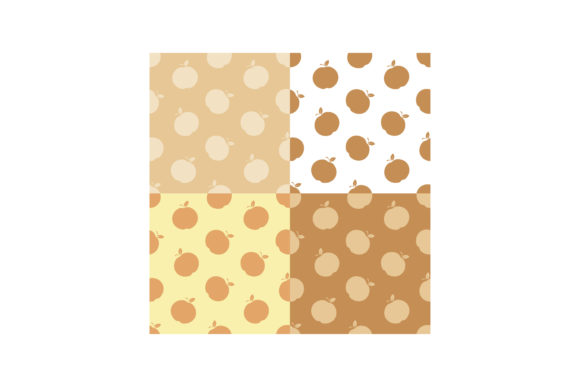
Color harmony also plays an outsized role. While the apple’s red is a natural focal point, considering the supporting palette—the greens of leaves, the browns of stems, the neutral of a backdrop—prevents visual chaos. A cohesive set often includes variations: one pattern with a white background for a clean, airy feel; another with a dark, moody background for dramatic contrast; and a third with a monochromatic or tonal rendering for subtle texture. Beyond color, line quality matters. Hand-drawn, imperfect strokes convey whimsy and organic charm, while crisp, symmetrical vectors suggest precision and modernity. Understanding these nuances helps buyers and users select the right seamless pattern for their specific context.
Practical Applications Across Industries
The usefulness of a seamless sweet apple pattern extends far beyond the expected. It’s easy to imagine such a design on kitchen textiles or school supplies, but the reach is broader. In packaging design, a delicate apple repeat can elevate a brand of organic fruit snacks, craft cider, or natural skincare products. The pattern implies freshness and authenticity. When printed on tissue paper or box interiors, it adds a thoughtful unboxing experience. For Set of Seamless Patterns with Sweet Apple, considering the end material is crucial: the same digital file might work on absorbent paper for wrapping but require adjusted colors for printing on glossy packaging to prevent muddiness.
Web and app designers also harvest the potential of these patterns. A subtle apple motif can serve as a background for a food blog, a recipe app, or an educational site about nutrition. Because seamless patterns are tileable, they load efficiently as small images or CSS backgrounds, keeping sites fast. For educators, a cheerful apple pattern can decorate classroom newsletters, reward charts, or interactive whiteboard backgrounds without distracting from content. Hobbyists and crafters find them invaluable for scrapbook paper, fabric for homemade quilts, or even as an imaginative desktop wallpaper. The versatility is rooted in the pattern’s ability to repeat infinitely at any size without visible seams, adapting to both digital pixels and physical threads.
Business owners in the hospitality industry might commission custom variations. A boutique hotel in a fruit-growing region could use a refined apple pattern on menus, staff scarves, and throw pillows, tying the guest experience to the local landscape. A café could incorporate the motif into its loyalty cards and window decals, making the brand memorable through repeat exposure. In each case, the seamlessness matters: when a design feels continuous, it conveys stability and attention to detail, qualities that reflect well on the business itself.
Creating Your Own Sweet Apple Seamless Pattern
For those inclined to craft rather than purchase, the process of designing a seamless pattern with sweet apples is both technical and artistic. It begins with gathering reference imagery: photographs of real apples, botanical illustrations, or sketches that capture the desired character. The designer then isolates one or more apple motifs, along with supporting elements like leaves, half-apples, seeds, or even a stylized slice. These are arranged within a square canvas, with special care taken at the edges. The classic approach is to draw the central area first, then duplicate any motif that touches a side to the opposite side, ensuring that when the tile repeats, the edge elements connect perfectly.
Using a vector illustration program, one can create a Set of Seamless Patterns with Sweet Apple by grouping the elements and using the software’s pattern-making tool, which automates much of the edge matching. Still, a human eye is needed to avoid awkward overlaps or unnatural gaps. A good test is to look at a preview of a large area filled with the pattern; any jumping-out lines or unintended clusters will become apparent. Adjusting transparency, rotation, and scale variation within the tile can prevent the dreaded “stamped” look, where the repeat is too obvious. A successful seamless pattern hides its own structure, presenting a unified whole.
Choosing the Right File Format and Resolution
Once the design is finalized, export settings determine its usability. For print, a high-resolution raster file—typically 300 DPI—in a lossless format like TIFF or PNG with transparency is ideal. Vector formats like EPS or SVG are even more flexible, allowing scaling to any dimension without quality loss. A seamless pattern delivered as a vector tile can be applied to a billboard just as smoothly as to a business card. When distributing a Set of Seamless Patterns with Sweet Apple digitally, providing a preview image alongside the actual pattern tile helps users see the repeat in action before purchase.
For digital use, considerations shift toward file size and color space. An RGB JPEG at 72 DPI may suffice for a website background, but a transparent PNG allows the pattern to overlay colored containers. Some creators also offer a “pattern swatch” file for Adobe Photoshop or Illustrator, which installs directly into the software’s pattern library for instant use. Additionally, providing a license that clearly states whether the pattern can be used for commercial products, altered, or redistributed is an essential layer of the package. Many buyers appreciate a small preview of the pattern applied to a mock-up—a tote bag, a phone case, a stationery set—to visualize its end-use potential.
Trends Shaping Fruit Motif Patterns Today
Current design trends influence how a sweet apple pattern might look and be received. The move toward sustainability and organic forms has boosted demand for hand-drawn, imperfectly charming motifs over hyper-realistic digital renderings. Watercolor textures, woodblock print effects, and even risograph-style graininess are popular because they feel human-made and warm. A Set of Seamless Patterns with Sweet Apple in this style might include subtle paint splatters or irregular outlines, making the pattern feel like a piece of art rather than a manufactured file.
Minimalism is another influential current, leading to patterns where apples are distilled to a few simple geometric shapes on a clean background. This approach works exceptionally well in modern interiors and tech accessories. Conversely, maximalism celebrates abundance—a dense pattern teeming with apples, blooms, vines, and maybe even whimsical characters hidden among the foliage. Tapping into nostalgia, some designs evoke vintage fruit crate labels or 1950s kitchen linens, using slightly faded color palettes and retro typography when paired with the pattern in branding. Staying aware of these trends helps designers position their work, but the timeless nature of the apple ensures that even a classic, trend-agnostic pattern retains value.
Overcoming Common Challenges in Seamless Repeats
Even experienced designers encounter pitfalls when creating seamless repeats of organic shapes like apples. One common problem is the unintentional creation of “rivers” or “tracks”—lines of similar spacing that the eye perceives as a pattern within the pattern. This can occur when apples are too evenly distributed or aligned in rows. Introducing subtle variation in size, angle, and spacing breaks up these tracks. Another issue is color vibration: a strong red apple on a complementary green background can cause an unpleasant optical shimmer, especially at small scales. Muting one of the colors or adding a neutral buffer between them solves this.
For a Set of Seamless Patterns with Sweet Apple intended for fabric, it’s wise to consider how the pattern will look when draped or wrapped. A perfectly flat digital tile doesn’t account for stretching or folding. Testing on a 3D mock-up can reveal if an apple becomes distorted awkwardly at the elbow of a shirt. Some designers intentionally build in a degree of busyness or scattered small elements that disguise such distortions. Finally, cultural context should not be overlooked; while the apple is broadly positive, in some uses (like children’s items) it may need to avoid resemblances to poisoned or forbidden fruit imagery. Sensitivity in execution—avoiding a gloomy or menacing tone—keeps the motif aligned with the intended sweet, cheerful vibe.
Integrating the Pattern into a Broader Design System
A seamless pattern rarely stands alone. It works best when part of a coordinated visual language. A home décor collection might pair a bold apple pattern with a simple polka dot, an understated stripe, and a solid fabric in the exact red of the apple. This allows decorators to mix and match without clash. In branding, the apple pattern could be used as a supplementary element—appearing in the background of a brochure or on the interior flap of an envelope—while the primary logo remains a crisp, un-patterned version. Thinking of a Set of Seamless Patterns with Sweet Apple as a tool rather than a centerpiece opens more possibilities. It can be scaled down to act as a texture behind text, as long as contrast remains legible.
Digital interfaces benefit from a light touch: an apple pattern used behind a semi-transparent container or as a loading screen graphic adds personality without demanding attention. Developers can implement the pattern via CSS background-repeat, adjusting size with background-size and even flipping or rotating tiles to reduce predictability. When the pattern is part of a larger UI kit, providing variations—like a dark mode version with reduced opacity—ensures accessibility. For creatives, the seamlessness allows it to be cropped in infinite ways; a bold square of the pattern can become an avatar background, while a wide strip becomes a Twitter header. This flexibility enhances the value proposition for anyone purchasing or downloading the design.
Evaluating Quality and Making Informed Choices
For consumers and professionals purchasing such patterns, a few checks can prevent disappointment. Inspect the tile preview at 100% zoom to ensure no halos or jagged edges betray the seam. If the pattern is raster-based, confirm that the physical dimensions and resolution match the intended use—a file sized at 10x10 inches at 300 DPI may be overkill for web but necessary for print. Read the license terms carefully: some allow unlimited commercial use, while others restrict the number of sales or require attribution. A true Set of Seamless Patterns with Sweet Apple should be diverse enough to offer at least four or five distinct variations, not just recolorings of the same tile. Look for sets that provide both light and dark backgrounds, different scales, and at least one alternative motif arrangement, such as a scattered pattern versus a directional one.
Finally, consider the emotional tone the pattern conveys before committing. Does it feel playful or sophisticated? Energetic or serene? Requesting a sample or downloading a free sampler can provide insight. Seeing the pattern in context—on a fabric swatch or as a phone case mock-up—often reveals unexpected strengths or weaknesses. The best seamless patterns are those you can imagine living with over time, whether as a shower curtain or a brand identity, without the charm fading. The sweet apple, with its layered meanings and enduring appeal, has the potential to age gracefully when woven into a design that respects the fundamentals of craft and usability.